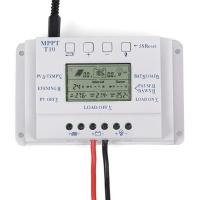
MPPT Solar Controller Regulator for 60A Maximum Current and
Automatic Max Power Tracking 12V/24V/36V/48V/60V/72V/96V
Here are the core advantages of MPPT technology, integrated with
the functions of inverters and PV panels:
1. Maximized Energy Harvest (Up to 30% More Efficiency)
Unlike traditional PWM controllers, an MPPT controller tracks the
varying voltage output of solar panels throughout the day.
The "Panel vs. Battery" Mismatch: Solar panels operate at a higher voltage than battery banks
require (e.g., a 12V battery needs 14.4V to charge, but a panel
might output 18-22V).
The MPPT Advantage: The MPPT controller converts the excess voltage into additional amperage. This is particularly crucial on cloudy days, in the early
morning, or late afternoon when sunlight is weak.
Integration Context: By ensuring the battery bank is fully charged faster, the MPPT
controller allows the inverter to draw from a healthier, more sustained DC source, resulting in
longer AC runtime for connected loads.
2. High System Voltage Flexibility (Lower Cable Costs)
MPPT controllers allow for a significant mismatch between the PV
array voltage and the battery voltage.
The Advantage: You can wire solar panels in series to achieve high input voltages (e.g., 100V, 150V, or even 600V in
larger systems).
Integration with PV Panels: Wiring in series reduces the current (Amperage) traveling from the
panels to the controller.
Cost Implication: Lower current means you can use much thinner, less expensive
copper cables over long distances (e.g., from a roof-mounted array
to a ground-level equipment room). This is impossible with PWM
controllers, which require panels to be wired in parallel (high
current, thick expensive cables).
3. Compatibility with High-Efficiency (Grid-Tie) Panels
Modern PV panels (often 60-cell or 72-cell) are designed for grid-tie systems and
have higher voltage outputs (Vmp often > 30V).
The Problem: A standard controller cannot charge a 12V or 24V battery from a
40V panel without wasting massive amounts of power.
The MPPT Solution: MPPT controllers bridge this technological gap. They allow the use
of these modern, readily available, and often cheaper "residential"
solar panels in off-grid systems.
Inverter Synergy: This allows for the creation of hybrid systems where high-voltage
DC arrays charge batteries via MPPT, and a hybrid inverter manages
both battery storage and grid interaction seamlessly.
4. Superior Performance in Cold Climates
Solar panels perform more efficiently in cold weather, producing
higher voltages.
The Advantage: MPPT controllers actively compensate for this. As voltage rises in
the cold, the MPPT algorithm adjusts to extract the maximum power
without damaging the system.
The Risk Mitigation: Without MPPT, the extra voltage from cold panels is either wasted
or can damage the charge controller. MPPT technology captures this
"cold weather bonus" to deliver extra charging power to the
batteries, ensuring the inverter has ample power for heating loads
during winter.
5. Enhanced Battery Health and Longevity
MPPT controllers are not just about power collection; they are about precise power delivery.
Advanced Charging Profiles: They utilize multi-stage charging (Bulk, Absorption, Float, and
Equalization) tailored specifically to the battery chemistry (AGM,
Gel, Lithium, Flooded).
Inverter Context: A battery that is charged with the precise profile required by an
MPPT controller maintains a higher state of health. This ensures
that when the inverter demands high surge currents (e.g., starting a refrigerator or a
water pump), the battery can deliver the necessary power without
voltage sag, preventing low-voltage shutdowns.
6. Scalability for Hybrid and Off-Grid Systems
MPPT technology is the cornerstone of modern system scalability.
System Expansion: It allows for "oversizing" the PV array. You can add more solar
panels than the controller's output rating, knowing that the MPPT
will simply clip the peak output on perfect days but produce
maximum power during suboptimal conditions.
Inverter Integration: Modern "MPPT Solar Charge Controllers" are often integrated
directly into Hybrid Inverters. This creates a single-box solution that manages DC solar input,
battery management, and DC-to-AC conversion, simplifying
installation and monitoring.
| PRODUCT | MPPT SOLAR CONTROLLER |
|---|
| Model | 30A | 40A | 50A | 60A |
|---|
| Charging Mode | MPPT automatic maximum power tracking |
| Charging Method | MPPT tracks maximum power, fast chargebalanced charge, and float
charge |
| BatteryType | Lead Acid | Single voltage 3.2 number of strings(strings-45 strings adjustable) |
| Gel | Single voltage 3.7 number of strings(2strings-45 strings
adjustable) |
| LifePo 4 | Adjustable limit voltage for equal chargefloat charge and DC
discharge: 8V-170V |
| Li-ion | With photovoltaic input, there is charging voltage(activate
lithium battery), can be used without battery DCoutput |
| USER | 0-230V |
With lithium battery
activation function | With photovoltaic input, there is charging voltage(activate lithium
battery), can be used without battery DC output |
PV maximum open
circuit input voltage | 0-230V |
| Max.pv Input Power | 12V-18V540W | 12V-18V720W | 12V-18W900W | 12V-18W1080W |
| 24V-36V1080W | 24V-36V1440W | 24V-36V1800W | 24V-36V2160W |
| 36-54V1620W | 36V-54V2160W | 36V-54V2700W | 36V-54V3240W |
| 48V-72V2160W | 48V-72V2880W | 48V-72V3600W | 48V-72V4320W |
| 96V-144V4320W | 96V-144V5760W | 96V-144V7200W | 96V-144V8640W |
| Product size | 202*215*100mm | 202*215*100mm | 218*265*100mm | 218*265*100mm |
| NWJG.W | 30A NW:19KGG.W2.2KG | 40A:N.W1.9KGG.W2.2KG | 50A:NW2.6KGG.W3KG | 60A: NW2.6KGG.W3KG |

MPPT controllers offer a wide range of battery compatibility,
easily connecting to lead-acid, lithium iron phosphate, and lithium
batteries, giving you more flexibility in your energy choices.
Regardless of your energy needs, MPPT controllers provide you with
more energy freedom and more choices!
The MPPT Controller not only ensures efficient energy conversion
but also features integrated WIFI connectivity for real-time
monitoring and remote control, offering a smarter and more
convenient way to manage your energy resources.
MPPT controller, thoughtful multiple protection programs, to
provide a full range of security for your energy system, so that
you can use more assured, peace of mind to enjoy the convenience of
clean energy and reliable
The MPPT controller is equipped with a smart fan cooling system to
efficiently reduce temperature and ensure continuous system
operation, providing excellent performance and stability for your
energy management. Not only smart, but also efficient